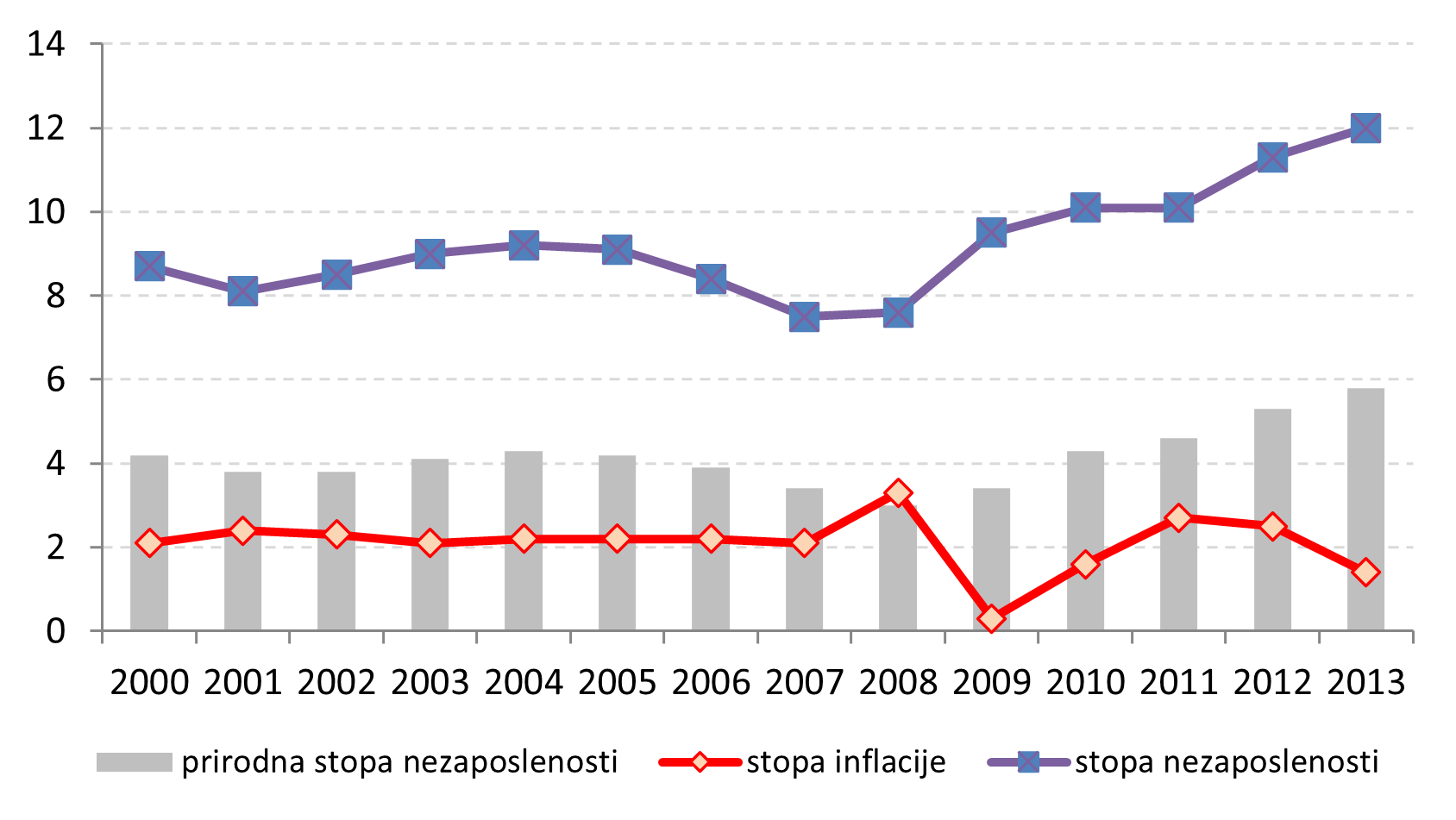
Kratkoročni, inverzni kompromis u EU viri iz Filipsove krive: niže stope nezaposlenosti obično podstiču veći rast plata i inflaciju, dok visoka nezaposlenost usporava rast plata, smanjujući inflaciju. Ovaj odnos proizilazi iz konkurencije na tržištu rada; kada je radnika malo, plate rastu, prenoseći troškove na potrošače.
Sa padom privredne aktivnosti u početnim godinama svetske ekonomske krize (2008. i 2009. godina) dolazi do pada BDP-a. Uz to, pad privredne aktivnosti odmah se odražava na pad cena, tj. smanjenje inflacije ali i rasta nezaposlenosti. Stopa inflacije ipak se smanjuje, jer i pored stagnacije ili blagog pada cena u tercijarnom sektoru, najveći pad cena beleže proizvodi iz sekundarnog, pa i primarnog sektora. Poslednja dva sektora vuku opšti nivo cena na dole i stopa inflacija se smanjuje, preteći da pređe u deflaciju čime se promoviše finansijska nestabilnost i podstiče žestoka ekonomska kontrakcija. Takva situacija pogoduje rastu nezaposlenosti. Otuda, problemi se šire sa jedne ekonomije na drugu. Zemlje periferije prve se suočavaju sa padom privredne aktivnosti i visokim stopama nezaposlenosti.
Pritisci iz Brisela da se kontrakcionim merama bori protiv krize dodatno usporavaju privrednu aktivnost i snižavaju cene. Pad stopa inflacije značajno ograničava ove ekonomije kroz dalji pad BDP-a i rast nezaposlenosti. Drugim rečima, mehanizam nam pokazuje da su ove ekonomije, da bi dostigle opštu ravnotežu, prinuđene na deflatorne mere prilagođavanja koje ih, zapravo, udaljavaju od ravnoteže. To podrazumeva da zemlje periferije moraju još snižavati cene kako bi unutar unije na zajedničkom tržištu bili konkurentni. Međutim, to im ne polazi za rukom zbog dvobrzinske integracije EU, između centra i periferije.
Zemlje centra sprovode model čvrste kontrole i regulisanja tržišta, sa akcentom na inflaciji a ne na BDP-u i zaposlenosti, dok zemlje periferije model „slobodnog“ tržišta, upravljanja tražnjom, održavanja visokog rasta i niske inflacije. Zemlje periferije su dodatno opterećene rastućim deficitom budžeta i rastom javnog duga.
Izvor: EUROSTAT
The short-term inverse trade-off in the EU emerges from the Phillips curve: lower unemployment rates usually stimulate faster wage growth and higher inflation, while high unemployment slows wage growth and reduces inflation. This relationship stems from competition in the labour market; when labour is scarce, wages rise, transmitting costs to consumers. With the decline in economic activity in the initial years of the global economic crisis (2008 and 2009), GDP fell. At the same time, the downturn in economic activity immediately led to lower prices, i.e. a decline in inflation, but also to rising unemployment.
The inflation rate nevertheless decreased because, despite stagnation or a mild fall in prices in the tertiary sector, the largest price declines were recorded in the secondary and even the primary sector. These two sectors pulled the overall price level downward, reducing inflation and threatening a transition into deflation, thereby promoting financial instability and triggering a sharp economic contraction. Such a situation favours the growth of unemployment. Consequently, problems spill over from one economy to another. Peripheral countries are the first to face declining economic activity and high unemployment rates.
Pressure from Brussels to combat the crisis through contractionary measures further slows economic activity and lowers prices. Falling inflation rates significantly constrain these economies through additional GDP decline and rising unemployment. In other words, the mechanism shows that, in order to reach general equilibrium, these economies are forced into deflationary adjustment measures that actually move them further away from equilibrium. This implies that peripheral countries must reduce prices even more to remain competitive within the Union’s single market. However, this proves difficult due to the EU’s two-speed integration between the core and the periphery.
Core countries implement a model of strong market control and regulation, with an emphasis on inflation rather than GDP and employment, while peripheral countries follow a model of “free” markets, demand management, high growth, and low inflation. Peripheral countries are additionally burdened by growing budget deficits and rising public debt.
Source: EUROSTAT