Realne plate sada rastu iz godine u godinu, ali ostaju ispod nivoa iz 2019. godine u mnogim zemljama. Međugodišnji rast realnih plata je pozitivan, pošto je inflacija opala, a rast nominalnih plata porastao. Prema realnim platama po satu – plate prilagođene inflaciji – stanovnici Sjedinjenih Država, Kanade, Japana, Australije i mnogim evropskim zemljama sada imaju manje novca na raspolaganju nego pre četiri godine.
Sa pandemijom su nastajali probleme u svim privredama, a države su počele da plaćaju radnike više usled potresa u zapošljavanju. Dodatno, ukrajinska kriza početkom 2022. godine, je pogodila realne plate usled skoka inflacije, uzrokujući da povećanje cena efektivno nadmašuje svaki potencijalni rast plata.
Prema poslednjim podacima za Q1 2024. godišnji rast realnih zarada bio je pozitivan u 29 zemalja od 35 zemalja (prosek OECD je +3,5%). Godišnji rast realnih plata ostao je negativan u Belgiji, Kanadi, Francuskoj, Japanu, Novom Zelandu i Švedskoj. Rast realnih plata je generalno rezultat ublažavanja inflacije, dok je rast nominalnih plata ostao stabilan ili blago usporen.
Faktori koji su doprineli ukupnom poboljšanju godišnjeg rasta realnih plata tokom protekle godine su zategnuta tržišta rada, povećanje zakonskih minimalnih plata i prilagođavanja ugovorenih plata. Realni rast ugovorenih plata poboljšao se tokom 2023. godine i ostao negativan samo u nekoliko zemalja. U Q1 2024. ugovorene plate su realno porasle u odnosu na prethodnu godinu u Austriji, Kanadi, evrozoni, Nemačkoj, Italiji, Holandiji i Sjedinjenim Državama, ali su nastavile da blago opadaju u Australiji i Švedskoj, a stabilizovale se nakon godinu dana u Belgiji.
Uprkos nedavnom porastu njihovog međugodišnjeg rasta, realne plate ostaju ispod nivoa pre COVID-19 u većini zemalja, iako je prosečna promena u svih 35 zemalja. Do prvog kvartala 2024. realne zarade su povratile bar deo izgubljenog položaja u 23 od 27 zemalja u kojima su pale nakon krize COVID-19 – u 11 zemalja porasle su iznad nivoa pre pandemije. Međutim, realne plate su ostale znatno ispod nivoa pre pandemije u praktično svim zemljama u kojima su najviše padale.
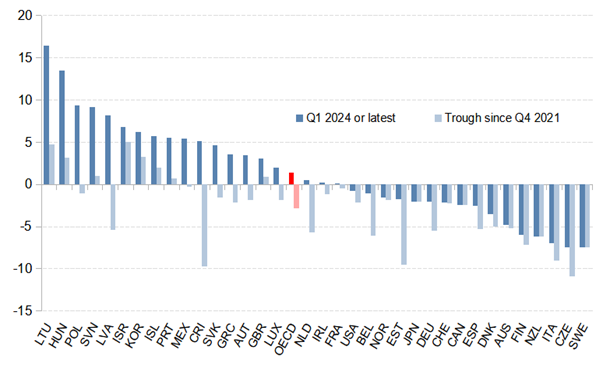
U Q1 2024, realne zarade su i dalje bile ispod nivoa iz Q4 2019 u 16 od 35 zemalja. Naviše su pogođene Finska, Italija, Češka Republika, Švedska i Novi Zeland, gde su realne plate smanjene za više od 5%. U Švedskoj, zemlji sa relativno niskim realnim platama i visokim životnim standardom, su plate najviše smanjile, za 7,5%. Inače, od Švedske više realne plate ima susedna Danska (11%), Nemačkoj, Holandiji ili Norveškoj (od 16 do 20%). Sindikati pregovaraju o većinskim ugovorima ali je pregovaračka pozičija nedovoljno dobra pa je kolektivno pregovaranje postalo spornije. Nasuprot njima, u Sjedinjenim Državama realne plate po satu su bile samo 0,8% niže u K1 2024. nego u K4 2019, u Kanadi 2,4%, dok je gubitak bio veći u Australija sa 4,8%.
Izvor: OECD
Slika: Rast realnih plata, Kumulativna procentualna promena realne satnice od četvrtog kvartala 2019
Real wages are now rising year-on-year, but remain below 2019 levels in many countries. Year-on-year growth in real wages is positive, as inflation has declined and nominal wage growth has increased. According to real hourly wages – wages adjusted for inflation – residents of the United States, Canada, Japan, Australia and many European countries now have less money on hand than they did four years ago.
With the pandemic, problems arose in all economies, and states began to pay workers more due to the upheaval in employment. Additionally, the Ukrainian crisis in early 2022 hit real wages due to a spike in inflation, causing price increases to effectively outpace any potential wage growth.
According to the latest data for Q1 2024, the annual growth of real wages was positive in 29 countries. 35 countries (OECD average is +3.5%). Annual real wage growth remained negative in Belgium, Canada, France, Japan, New Zealand and Sweden. Growth in real wages is generally the result of easing inflation, while growth in nominal wages has remained stable or slightly slowed.
Factors that contributed to the overall improvement in annual real wage growth over the past year were tight labor markets, increases in legal minimum wages, and adjustments to contracted wages. The real growth of contracted wages improved during 2023 and remained negative only in a few countries. In Q1 2024, contracted wages rose year-on-year in real terms in Austria, Canada, the Eurozone, Germany, Italy, the Netherlands and the United States, but continued to decline slightly in Australia and Sweden, but stabilized after a year in Belgium.
Despite the recent uptick in their year-on-year growth, real wages remain below pre-COVID-19 levels in most countries, although the average change is across all 35 countries. By the first quarter of 2024, real wages had regained at least some of their lost ground in 23 of the 27 countries where they fell after the COVID-19 crisis – in 11 countries they rose above their pre-pandemic levels. However, real wages remained well below pre-pandemic levels in virtually all countries where they fell the most.
In Q1 2024, real wages were still below the level of Q4 2019 in 16 out of 35 countries. Finland, Italy, the Czech Republic, Sweden and New Zealand were hit the hardest, where real wages fell by more than 5%. In Sweden, a country with relatively low real wages and a high standard of living, wages decreased the most, by 7.5%. By the way, neighboring Denmark (11%), Germany, the Netherlands or Norway (from 16 to 20%) have higher real wages than Sweden. Unions negotiate majority contracts, but the negotiating position is not good enough, so collective bargaining has become more contentious. By contrast, in the United States real hourly wages were only 0.8% lower in Q1 2024 than in Q4 2019, in Canada 2.4%, while the loss was greater in Australia at 4.8%.
Source: OECD
Figure: Real wage growth, Cumulative percentage change in real hourly wage since Q4 2019