Iskustva iz globalnih kriza i eksternih šokova pokazala su da su ekonomije zasnovane na realnom sektoru znatno otpornije. Izbor pravih sektora je ključan, ali je još važnije ne zapostaviti one koji obezbeđuju stabilnost i kontinuitet. Kada ključni sektori slabe, ekonomija ne usporava samo – ona zaostaje. Tehnološko i ekonomsko zaostajanje se vremenom produbljuje. Srbija nije zamenila opadajuće sektore snažnijim, već slabijim ili fragmentisanim aktivnostima.
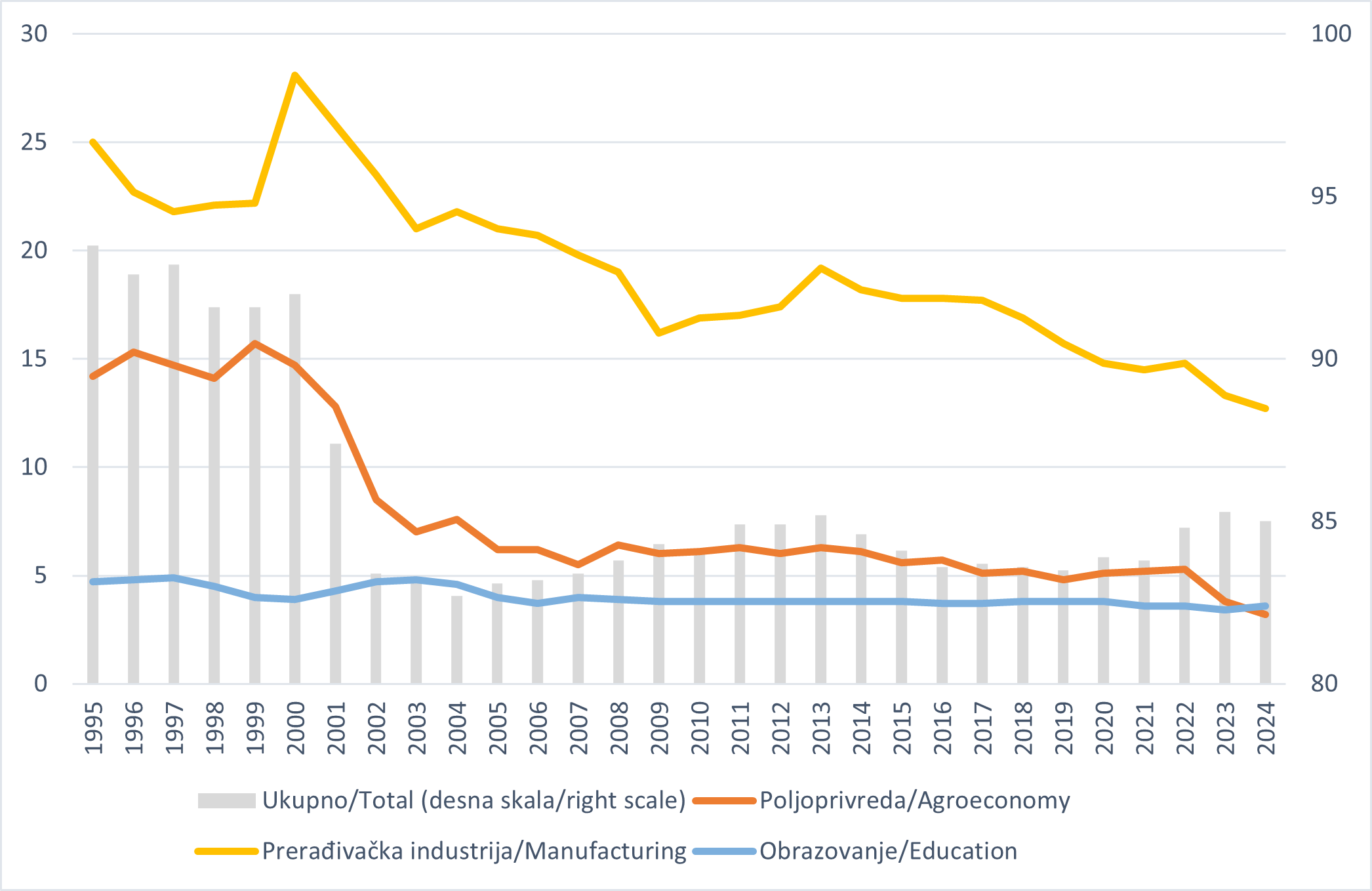
Današnja srpska ekonomija je visoko zavisna ekonomija. Posmatrano kroz proizvodnu funkciju, rast se oslanja na strani kapital (SDI i zaduživanje), rad (uvoz radne snage i odliv mozgova) i tehnologiju (uvoz tehnologije, niska tehnološka intenzivnost i imitaciona proizvodnja). Koreni ove zavisnosti leže u slabljenju tri ključna sektora: poljoprivrede (bezbednost hrane i stabilnost), obrazovanja (znanje, veštine, inovacije) i prerađivačke industrije (proizvodni kapacitet i otpornost). Njihov pad je kontinuiran i merljiv – udeo prerađivačke industrije opao je sa 25% na 12,7%, poljoprivrede sa 14,2% na 3,2%, a obrazovanja sa 4,9% na 3,6%. Istovremeno, udeo dodate vrednosti na nivou privrede smanjen je sa 93% na 85%, što potvrđuje da novi sektori nisu nadomestili gubitak ovih ključnih aktivnosti.
Zašto su ova tri sektora ključna? Zato što čine osnovu endogenog rasta. Oni obezbeđuju sigurnost, kontinuitet i sposobnost rasta zasnovanog na domaćim kapacitetima. U njihovom odsustvu, rast postaje spolja vođen i strukturno krhak. Produženi period slabog i nestabilnog rasta, posebno tokom 2008-2017. godine, nije rezultat uobičajenih poslovnih ciklusa, već strukturne neravnoteže. Umesto endogenog rasta, ekonomija se pomerila ka egzogenom rastu – sve više zavisnom od eksternog finansiranja.
Ključna poenta je da isti pokretači rasta – kapital, rad i tehnologija – daju veoma različite rezultate u zavisnosti od strukture ekonomije i okvira ekonomske politike.
Strani kapital može ubrzati rast, ali samo ako je produktivan i integrisan u domaću ekonomiju. Kvalitetne SDI omogućavaju transfer tehnologije, uključivanje domaćih firmi u lance vrednosti i rast produktivnosti. U Srbiji je ovaj mehanizam ograničen. Domaća dodata vrednost je niska, zavisnost od stranih kompanija visoka, a proizvodnja se često svodi na montažne aktivnosti. Istovremeno, značajan deo SDI usmeren je ka sektorima niske produktivnosti, uključujući nekretnine i niskotehnološku industriju, sa slabim efektima prelivanja. Rezultat je jasan: radna mesta se stvaraju, ali rast produktivnosti ostaje skroman, a izvozni potencijal ograničen. Problem nije u obimu investicija, već u njihovoj strukturi i kvalitetu.
Rad je drugi ključni pokretač. U razvijenim ekonomijama rast se oslanja na visoko kvalifikovanu radnu snagu i snažne efekte preliva znanja. U Srbiji dominira suprotan trend. Kontinuirani odliv mozgova – posebno lekara, inženjera i IT stručnjaka – smanjuje razvojni potencijal zemlje. Gubitak ljudskog kapitala deluje kao skriveni porez na rast, slabi inovacioni kapacitet i usporava rast produktivnosti. Uvoz niskokvalifikovane radne snage može podržati kratkoročnu aktivnost, ali ne rešava strukturni problem i može dodatno ograničiti rast produktivnosti.
Tehnološki vođen rast ne zavisi samo od pristupa kapitalu, već i od sposobnosti da se tehnologija usvoji i unapredi. Uvoz tehnologije može podržati rast, ali samo kao prelazna faza ka inovacijama. Bez tog prelaza, ekonomija ostaje zarobljena u niskom i srednjem tehnološkom nivou. Srbija se suočava upravo sa tim problemom. Proizvodnja se u velikoj meri zasniva na imitacionim modelima, uz ograničena ulaganja u istraživanje i razvoj. Kao rezultat, rast produktivnosti je slab, a sofisticiranost izvoza niska. Imitacija bez unapređenja vodi direktno u zamku srednjeg dohotka.
Strukturni problem postaje najvidljiviji kroz konkretne ekonomske ishode.
U poljoprivredi, pad investicija povećao je troškove proizvodnje i usporio modernizaciju. Bez tehnološkog napretka, produktivnost opada, dok cene rastu. S obzirom na značaj hrane u potrošnji domaćinstava, to direktno smanjuje životni standard. Istovremeno, rast uvoza dodatno slabi domaće proizvođače i narušava samodovoljnost. Sektor postaje manje konkurentan i ranjiviji na spoljne šokove.
Prerađivačka industrija pokazuje sličan obrazac. Nedovoljna ulaganja, rastući tehnološki jaz i gubitak proizvodnih kapaciteta smanjili su konkurentnost i izvozni potencijal. Troškovi ostaju visoki, dok uvoz vrši pritisak na domaće proizvođače. Prelazak sa industrije sa inovacionim potencijalom na montažnu strukturu značajno je smanjio dodatu vrednost. Takav model ne može generisati održiv rast ni u srednjem roku.
Obrazovanje, kao temelj dugoročnog razvoja, pokazuje trajne slabosti. Ulaganja su niska, a sistem je više usmeren na kvantitet nego na kvalitet. Struktura obrazovanja sve više odražava strukturu ekonomije – tehnološki manje zahtevna ekonomija ne stvara tražnju za naprednim veštinama. Kao rezultat, inovacije su ograničene, istraživanje i razvoj nedovoljno finansirani, a prelazak ka ekonomiji zasnovanoj na znanju spor. Digitalizacija napreduje, ali bez adekvatne podrške ljudskog kapitala i tehnoloških kapaciteta.
Zaključak je jasan: bez snažne strukturne osnove, rast ostaje zavisan, fragmentisan i neodrživ. Problem nije samo koliko ekonomija raste, već šta pokreće taj rast – i da li su ti pokretači dovoljno snažni da ga održe na duži rok.
Izvor: RZS
Serbia’s Growth Without a Foundation Experiences from global crises and external shocks have shown that economies with a structure based on the real sector are significantly more resilient. Choosing the right sectors is crucial, but even more important is not to neglect those that ensure stability and continuity. When key sectors weaken, the economy does not just slow down – it falls behind. Technological and economic backwardness deepens over time. Serbia did not replace declining sectors with stronger ones. It replaced them with weaker or fragmented activities.
The Serbian economy today is a highly dependent economy. Viewed through the production function, growth relies on foreign capital (FDI and borrowing), labor (import of labor and brain drain), and technology (import of technology, low technological intensity and imitative production). The roots of this dependence lie in the weakening of three key sectors: agriculture (food security and stability), education (knowledge, skills, innovation) and the processing industry (productive capacity and resilience). Their decline is continuous and measurable – the share of the processing industry fell from 25% to 12.7%, agriculture from 14.2% to 3.2%, and education from 4.9% to 3.6%. At the same time, the share of value added generated by economy declined from 93% to 85%, confirming that new sectors have not compensated for the loss of these core activities.
Why are these three sectors critical? Because they form the foundation of endogenous growth. They provide security, continuity and the ability to grow based on domestic capacities. In their absence, growth becomes externally driven and structurally fragile. The prolonged period of weak and unstable growth, especially during 2008-2017, is not the result of normal business cycles, but of a structural imbalance. Instead of endogenous growth, the economy has shifted toward exogenous growth – increasingly dependent on external financing.
The key point is that the same growth drivers – capital, labor and technology – produce very different outcomes depending on the structure and policy framework.
Foreign capital can accelerate growth, but only if it is productive and embedded in the domestic economy. High-quality FDI generates technology transfer, integrates domestic firms into value chains and increases productivity. In Serbia, this mechanism remains limited. Domestic value added is low, dependence on foreign firms is high, and production is often reduced to assembly activities. At the same time, a significant share of FDI is directed toward low-productivity sectors, including real estate and low-technology manufacturing, with weak spillover effects. The result is clear: jobs are created, but productivity growth remains modest and export capacity limited. The problem is not the volume of investment, but its structure and quality.
Labor is another key driver. In advanced economies, growth is supported by highly skilled labor and strong knowledge spillovers. In Serbia, the opposite trend dominates. Continuous brain drain – especially of doctors, engineers and IT professionals – reduces the country’s development potential. The loss of human capital acts as a hidden tax on growth, weakening innovation capacity and slowing productivity improvements. The import of low-skilled labor may support short-term activity, but it does not solve the structural problem and may further limit productivity growth.
Technology-driven growth depends not only on access to capital, but on the ability to absorb and upgrade technology. Importing technology can support growth, but only as a transitional phase toward innovation. Without this transition, the economy remains trapped in low and medium technological intensity. Serbia faces precisely this problem. Production is largely based on imitative models, with limited investment in research and development. As a result, productivity growth is weak and export sophistication remains low. Imitation without upgrading leads directly into the middle-income trap.
The structural problem becomes most visible when translated into real economic outcomes.
In agriculture, declining investment has increased production costs and slowed modernization. Without technological progress, productivity falls, while prices rise. Given the importance of food in household consumption, this directly reduces living standards. At the same time, growing imports further weaken domestic producers and undermine self-sufficiency. The sector becomes less competitive and more vulnerable to external shocks.
The manufacturing reflects a similar pattern. Insufficient investment, a widening technological gap and the loss of production capacity have reduced competitiveness and export potential. Costs remain high, while imports increase pressure on domestic producers. The transition from an industry with innovation potential to an assembly-based structure has significantly reduced value added. Such a model cannot generate sustainable growth even in the medium term.
Education, as the foundation of long-term development, shows persistent weaknesses. Investment remains low, and the system is oriented more toward quantity than quality. The structure of education increasingly reflects the structure of the economy – a technologically less demanding economy does not generate demand for advanced skills. As a result, innovation is limited, research and development remain underfunded, and the transition toward a knowledge-based economy is slow. Digitalization is progressing, but without sufficient support from human capital and technological capabilities.
The conclusion is clear: without a strong structural base, growth remains dependent, fragmented and unsustainable. The problem is not only how much the economy grows, but what drives that growth – and whether those drivers are strong enough to sustain it over time.
Source: RZS