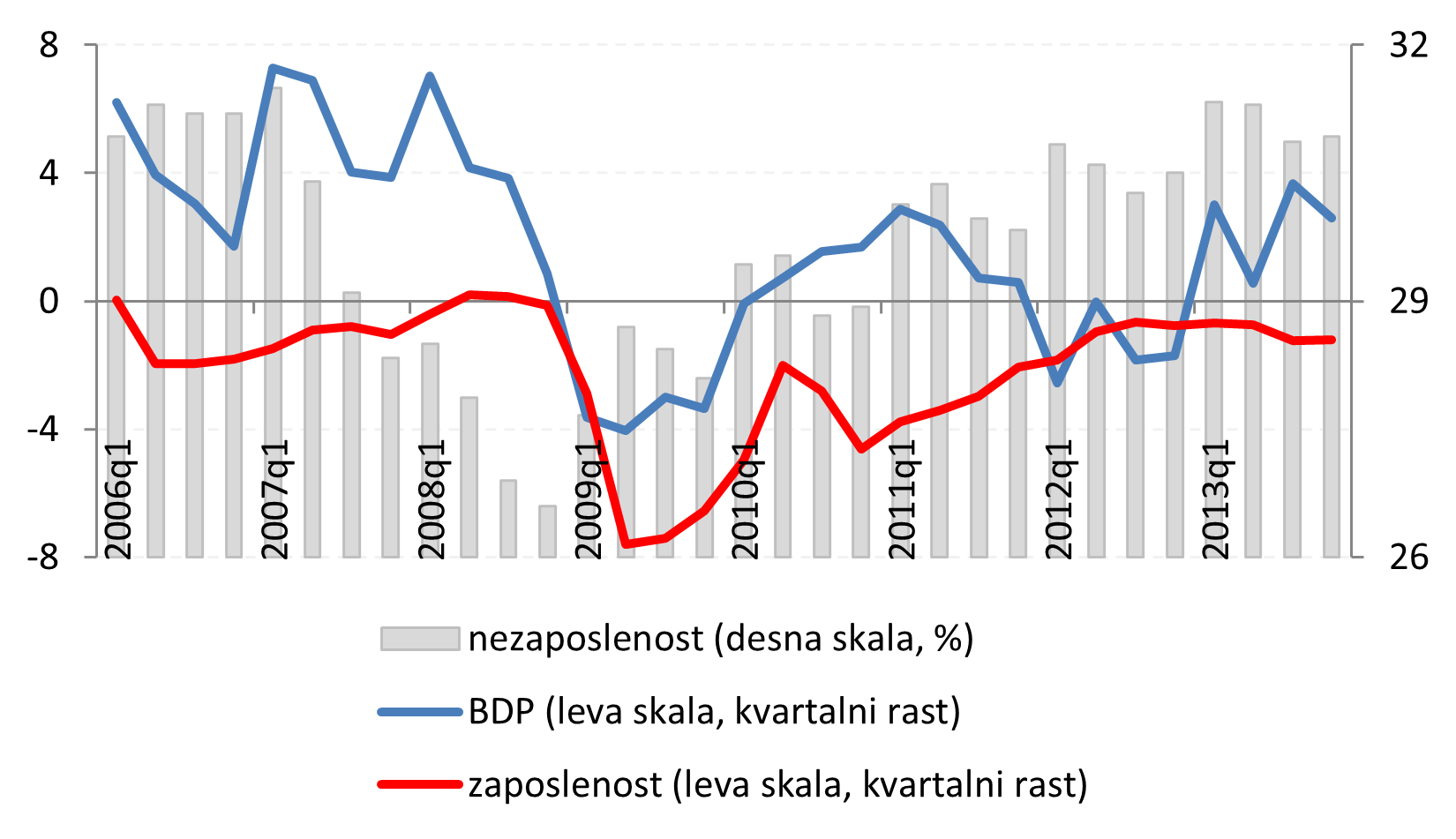
Najveći problem za srpsku ekonomiju je u tome što i u periodima kada je BDP beležio rast dolazilo je do rasta nezaposlenosti, mereno bilo preko Ankete o radnoj snazi (ARS) bilo formalno. Privreda Srbije je sve do krize beležila visoku prosečnu godišnju stopu privrednog rasta od 5,7%, ali i pored toga imala visoku nezaposlenost. Nezaposlenost je u periodu 2001-2013. godina rasla po prosečnoj godišnjoj stopi od 0,6%, dok je zaposlenost padala daleko brže, po prosečnoj godišnjoj stopi od 1,9%.
Privredna ekspanzija do 2008. godine uticala je na blago smanjivanje nezaposlenosti ali je nedostatak što je stopa zaposlenosti ostala veoma niska. Negativni efekti krize uticali su da nezaposlenost kontinuirano raste od 2009. godine, čak i u godinama kada raste BDP. Žestok pad je i kod stope zaposlenosti koja je u poslednjim godinama beležila blago povećanje ali su stope zaposlenosti i dalje negativne.
Problem u Srbiji po pitanju (ne)zaposlenosti potiče iz procesa transformacije privrede u tržišnu ekonomiju, a proizilazi iz sveobuhvatne liberalizacije i brze privatizacije – „šok terapija“. Ovaj proces u Srbiji dodatno je podržavan malicioznim stavovima interesnih grupa, nestručnim kreatorima ekonomske politike i nepotizmom. Zatvaranje brojnih preduzeća smanjilo je raspoložive proizvodne kapacitete i uticalo na manje potrebe za radnom snagom. Sa usporavanjem potencijalnog rasta privrede nema ni aktuelnog rasta privrede niti angažovanja neuposlenih kapaciteta (rasta zaposlenosti). Tokom posmatranog perioda nije bilo otvaranja novih proizvodnih pogona, najviše zbog makroekonomske neizvesnosti, pa nije bilo prostora za otvaranje novih radna mesta. Ostala neefikasna radna mesta su se popunjavala zahvaljujući mekom budžetskom ograničenju koje je tolerisala vlast. Na sve to treba dodati česta politička previranja, kao i posledice svetske ekonomsko-finansijske krize. Otuda, ne iznenađuje što se problem nezaposlenosti produbljuje.
Prema zvaničnim podacima formalne (ne)zaposlnenosti, broj zaposlenih u Srbiji u periodu 2003-2014. godina smanjen za oko 270 hiljada, a da se broj registrovano nezaposlenih povećao za oko 35 hiljada. Dakle, radi se o veoma nepovoljnom trendu u posmatranom periodu.
Podaci za 2012. godinu pokazuju da je u Srbiji u najvećem problemu populacija stanovništva sa srednjom stručnom spremom pošto čine skoro 60% svih zaposlenih, posmatrajući kvalifikacionu strukturu zaposlenih, ali istovremeno i 2/3 od ukupno nezaposlenih lica, posmatrajući strukturu nezaposlenih.
The greatest problem facing the Serbian economy is that even in periods when GDP recorded growth, unemployment continued to increase, whether measured through the Labour Force Survey (LFS) or official administrative data. Until the global crisis, the Serbian economy recorded a high average annual growth rate of 5.7%; nevertheless, unemployment remained high. In the period 2001-2013, unemployment increased at an average annual rate of 0.6%, while employment declined much faster, at an average annual rate of 1.9%.
Economic expansion up to 2008 contributed to a slight reduction in unemployment; however, the main shortcoming was that the employment rate remained very low. The negative effects of the crisis led to a continuous rise in unemployment from 2009 onward, even in years when GDP growth was recorded. A sharp decline was also observed in the employment rate, which showed only a modest recovery in recent years, yet overall employment trends remained negative.
The unemployment problem in Serbia originates from the process of economic transformation toward a market economy and stems from comprehensive liberalization and rapid privatization – so-called “shock therapy.” In Serbia, this process was further exacerbated by malicious behavior of interest groups, incompetent economic policymakers, and nepotism. The closure of numerous enterprises reduced available production capacities and lowered demand for labor. With the slowdown in potential economic growth, there was neither actual economic expansion nor activation of idle capacities (employment growth). During the observed period, there was no opening of new production facilities, largely due to macroeconomic uncertainty, leaving no room for job creation. Remaining inefficient jobs were preserved through soft budget constraints tolerated by the authorities. All of this was further intensified by frequent political instability and the consequences of the global economic and financial crisis. Therefore, it is not surprising that the unemployment problem has deepened.
According to official data on formal (un)employment, the number of employed persons in Serbia decreased by approximately 270,000 in the period 2003–2014, while the number of registered unemployed increased by about 35,000. This represents a highly unfavorable trend.
Data for 2012 show that the population with secondary education faces the greatest difficulties: they account for nearly 60% of total employment when considering the qualification structure of the employed, yet at the same time represent two-thirds of the total unemployed population when considering the structure of unemployment.