Koliko je budžet EU od 1,82 biliona evra (+ 540 milijardi evra podrške) pristupačan državama članicama, ako postoji uslovljanje za raspodelu sredstava?!? „Štedljive ekonomije“ su prihvatile dogovor, ali ostale sumnjičave zbog dugova koje treba vraćati decenijama. Razlog je jasan, doprinos pojedinih država članica budžetu EU, već skoro dve decenije, pada na teret malog broja država članica.
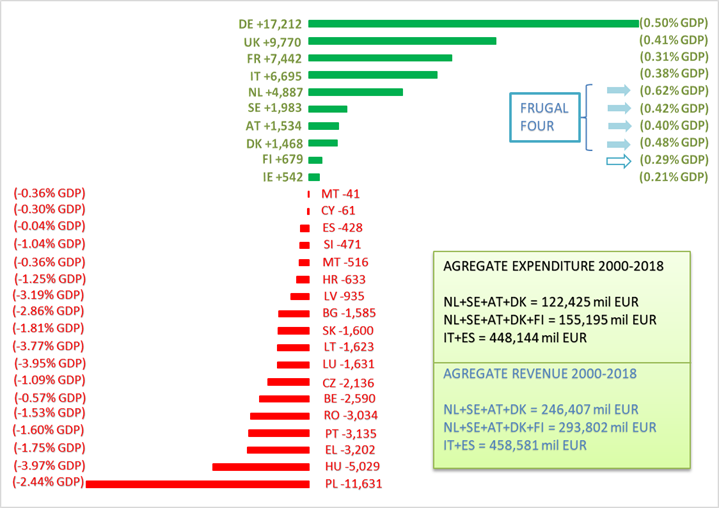
U 2018. godini deset država članica su uplatile više novca nego što su povukle sredstava iz budžeta EU. Dominira Nemačka sa 17,212 milijarde evra, a slede Velika Britanija sa 9,770 milijardi evra, Francuska sa 7,442 milijarde evra i Italija sa 6,695 milijardi evra. Poljska je najveći dobitnik u EU, jer povlači sredstava iz budžeta u većem obimu nego što uplaćuje, čak 11,631 milijardi evra. Slede Mađarska sa 5,029 milijardi evra i Grčka sa 3,202 milijarde evra.
Nemačka ekonomija je razvijena i dovoljno snažna tako da pored velikog doprinosa budžetu EU uspeva da ostvari direktne koristi od članstva u EU. Prema pojedinim izvorima (the Bertelsmann foundation) prosečni prihodi su povećani u Nemačkoj za preko 1000 evra. Slično je sa Francuskom. Nasuprot njima, manje ekonomije, iako su razvijene, nisu u mogućnosti da ostvare takve koristi od članstva pa su doprinosi bolniji i skupljiji. Tačka spoticanja u pregovorima bile su „štedljive ekonomije“ (Nizozemska, Švedska, Danska i Austrija, kasnije i Finska), koje su insititrale, od samog početka, na većem udelu pozajmica (360 milijarid evra) a manjem udelu bespovratnih sredstava (390 milijardi evra). Postoji bojazan od daljeg zaduživanja kroz zajednički fond za pomoć (uz garancije EU). Institucije EU će prikupljati sredstva na tržištima, koja će se vraćati u narednih 30 godina – od 2028. do 2058. godine.
„Štedljive ekonomije“, posmatrano prema učešću u BDP, doprinose u velikoj meri budžetu EU. Godinama unazad Nizozemska je davala najveći deo BDP u odnosu na ostale članice (u 2014. godini čak 1%). Visok udeo doprinosa budžetu prema GDP za 2018. godinu, u odnosu na ostale članice, imaju Nizozemske sa 0,62%, Danska sa 0,48%, Švedska sa 0,42%, Austrija sa 0,40% i Finska sa 0,29%. U periodu 2000-2018. godina, ove ekonomije su uplatile dvostruko više novca nego što su povukle novca iz budžeta EU, dok su Italija i Španija, zajedno uplatile 10 milijadi evra više nego što su povukli novca iz budžet EU. Od članica koje su povukle mnogo više novca nego što su uplatile u budžet EU izdvajaju se Mađarska (4,2 puta), Grčka (3,4 puta) i Poljska (3,2 puta).
Novi budžet (2021-2027) podrazumeva novi pristup sredstivma iz budžeta. Podginuta je granica doprinosa država članica za bužet EU na 1,23% (sa 1% u cilklusu 2014-2020) bruto nacionalnog dohotka, kao garacnija za zaduživanje na tržištu kapitala. Tri ključna zaključka nacrta budžeta odnose se na raspodelu sredstava iz budžeta, i to prema: 1) klimatskim promenama, 2) stepenu poštovanja vladavine zakona i 3) ekonomskom paketu (bespovratna sredstva + krediti) za suzbijanje efekata recesije izazvanih pandemijom COVID-19. Uz to, novi nacrt predviđa manje novca za poljoprivredu (7,5 milijardi evra, smanjenje sa 15 milijardi evra), smanjen fond za Horizon program za istraživanje i inovacije (sa 13,5 na 5 milijardi evra), prepolovljen investicioni fond (sa 2 na 1 milijardu evra), manje je novca i za kohezionu politiku (47,5 milijardi evra, smanjenje sa 50 milijardi evra), kao i za fond za pravednu tranziciju (sa 30 na 10 milijardi evra). Ostaje otvoreno pitanje, koliko dopustiti smanjenje pojedinih budžetski pozicija, a da se obezbede dovoljne koristi za države članice.
Izvor: kalkulacije autora na bazi podataka Evropske komisije
How much is the EU budget of 1.82 trillion euros (+ 540 billion euros of support) accessible to member states, if there is a condition for the distribution of funds?!? The „Frugal economies“ accepted the agreement but remained suspicious because of the debts that need to be repaid for decades. The reason is clear, the contribution of individual member states to the EU budget, for almost two decades, has been borne by a small number of member states.
In 2018, ten member states invested more in the EU than they withdrew from the budget. Germany dominates with 17.212 billion euros, followed by Great Britain with 9.770 billion euros, France with 7.442 billion euros and Italy with 6.695 billion euros. Poland is the biggest winner in the EU, because it withdraws funds from the budget in a larger amount than it pays, as much as 11.631 billion euros. It is followed by Hungary with 5.029 billion euros and Greece with 3.202 billion euros.
The German economy is developed and strong enough so that in addition to a large contribution to the EU budget, it manages to achieve direct benefits from EU membership. According to some sources (the Bertelsmann foundation), the average income has increased in Germany by over 1,000 euros. It is similar with France. In contrast, smaller economies, although developed, are unable to reap such benefits from membership, so contributions are more painful and expensive. The stumbling block in the negotiations came from the „frugal economies“ (the Netherlands, Sweden, Denmark and Austria, and later Finland), which insisted, from the very beginning, on a larger share of loans (360 billion euros) and a smaller share of grants (390 bilion euros). There are fears of further borrowing through a mutual fund (with EU guarantees). EU institutions will raise funds in the markets, which will return in the next 30 years – from 2028 to 2058.
„Frugal economies“, viewed in terms of share in GDP, contribute greatly to the EU budget. Years ago, the Netherlands accounted for the largest share of GDP compared to other members (in 2014, as much as 1%). A high share of budget contributions to GDP for 2018, compared to other members, have the Netherlands with 0.62%, Denmark with 0.48%, Sweden with 0.42%, Austria with 0.40% and Finland with 0, 29%. In the period 2000-2018. year, these economies paid twice as much money as they withdrew money from the EU budget, while Italy and Spain, together, paid 10 billion euros more than they withdrew money from the EU budget. The members that withdrew much more money than they paid into the EU budget are Hungary (4.2 times more), Greece (3.4 times more) and Poland (3.2 times more).
The new budget (2021-2027) implies a new approach to budget funds. The limit of member states’ contributions to the EU budget has been lowered to 1.23% (from 1% in the 2014-2020 cycle) of gross national income, as a guarantee for borrowing on the capital market. The three key conclusions of the draft budget relate to the distribution of budget funds, according to: 1) climate change, 2) the degree of compliance with the rule of law and 3) the economic package (grants + loans) to combat the effects of the recession caused by the COVID-19 pandemic. In addition, the new draft envisions less money for agriculture (€ 7.5 billion, a reduction of € 15 billion), a reduced fund for the Horizon Research and Innovation Program (from € 13.5 to € 5 billion), a halved investment fund (from € 2 billion). to 1 billion euros), there is less money for cohesion policy (47.5 billion euros, reduction from 50 billion euros), as well as for the fund for a fair transition (from 30 to 10 billion euros). The question remains, how much to allow the reduction of certain budget positions, while providing sufficient benefits for member states.
Source: author’s calculations based on European Commission data