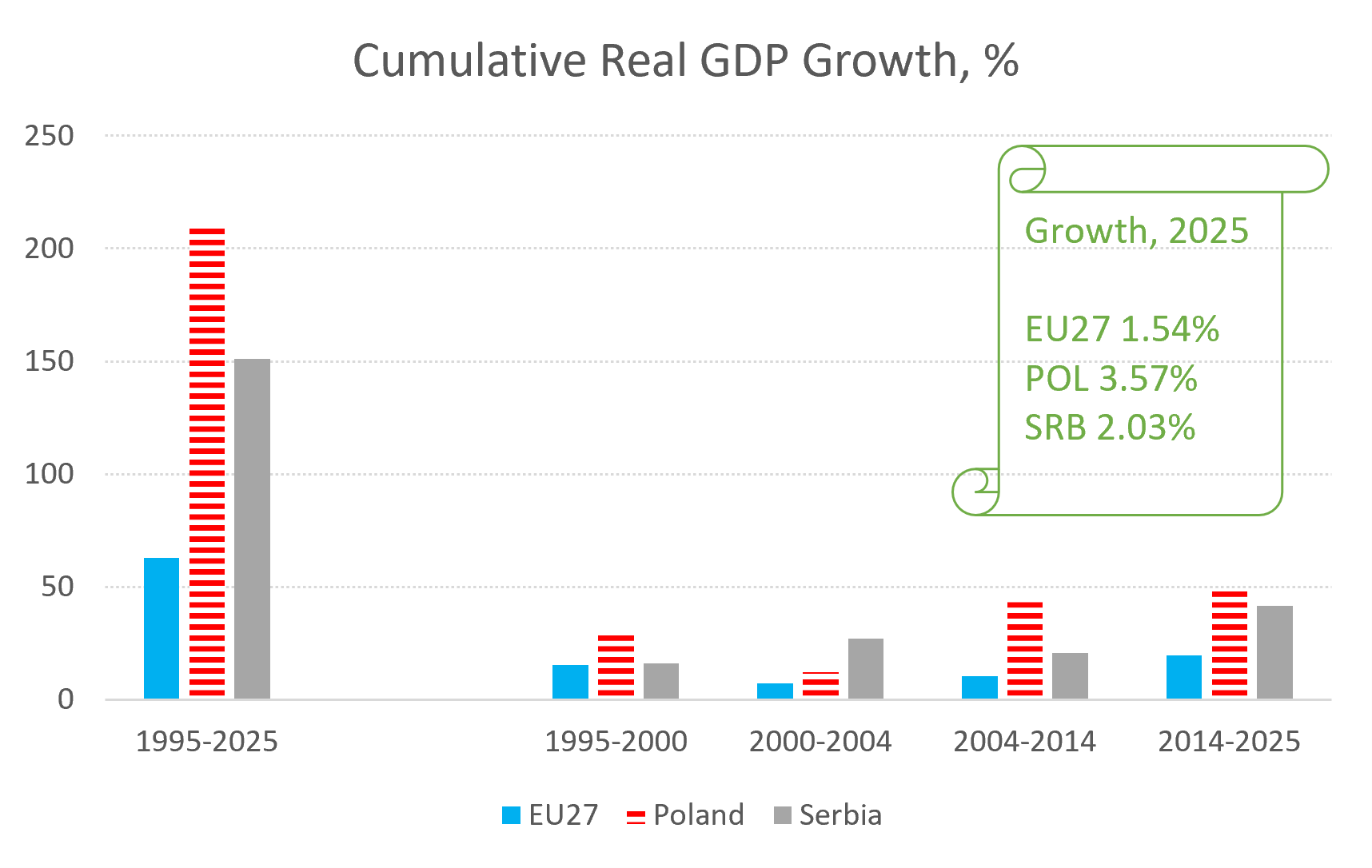
Kako je Poljska postala šesta najveća ekonomija u Evropskoj uniji, dok je Srbija, uprkos decenijama ekonomskog rasta, ostala daleko iza? Odgovor leži u matematici dugoročnog razvoja. Između 1995. i 2025. godine, realni BDP Poljske je porastao za 211,4%, u poređenju sa 150,9% u Srbiji. Poljska je rasla prosečnom godišnjom stopom od 3,86%, Srbija 3,11%. Godišnja razlika je bila samo 0,75 procentnih poena, ali je tokom tri decenije proizvela radikalno drugačiji ekonomski ishod. Poljska nije samo rasla; rasla je brže i duže. Centralni problem Srbije stoga nije odsustvo rasta, već nedovoljan rast za konvergenciju.
Poređenje ne bi trebalo da ignoriše istoriju. Srbija je doživela raspad Jugoslavije, ratove, sankcije, ekonomsku izolaciju i institucionalne poremećaje tokom 1990-ih. Poljska je takođe prošla kroz tešku tranziciju, ali se nije suočila sa istom kombinacijom šokova. Ove razlike objašnjavaju deo divergencije. Međutim, oni ne mogu objasniti sve. Prošlo je više od dvadeset pet godina od političke tranzicije Srbije posle 2000. godine. Ključno pitanje više nije samo šta se dogodilo sa Srbijom 1990-ih, već zašto je konvergencija ostala tako spora od tada.
Podaci pokazuju važnost složenog obračuna. Do 2025. godine, indeks realnog BDP-a Poljske, sa 1995. godinom jednakom 100, dostigao je 311,36, dok je srpski dostigao 250,92. Kumulativna prednost Poljske je stoga bila veća od 60 procentnih poena. Isti obrazac se pojavljuje i kod realnog BDP-a po glavi stanovnika. Poljska je dostigla indeks od 329,81, u poređenju sa 292,26 u Srbiji. Prosečan godišnji rast realnog BDP-a po glavi stanovnika bio je 4,06% u Poljskoj i 3,64% u Srbiji. Ponovo, godišnja razlika deluje skromno. Tokom trideset godina, to postaje razvojni jaz.
Analiza podperioda pokazuje da razlika između Poljske i Srbije nije bila jednolična tokom celog perioda 1995-2025. U periodu 1995-2000, Poljska je zabeležila kumulativni rast realnog BDP-a od 29,36%, u poređenju sa 15,86% u Srbiji. Nakon ove rano divergencije usledio je preokret u periodu 2000-2004, kada je Srbija porasla za 26,90%, znatno brže od poljskih 12,23%, što odražava oporavak srpske ekonomije nakon političkih i ekonomskih poremećaja 1990-ih. Međutim, ovaj period brzog rasta u Srbiji nije predstavljao trajni trend konvergencije. Od 2004-2014, Poljska je porasla za 44,64%, više nego dvostruko u odnosu na srpskih 20,66%, što označava period u kojem se jaz u razvoju najznačajnije proširio.
Najnoviji period, 2014-2025, predstavlja uravnoteženiju sliku. Poljska je nastavila brzo da raste, sa kumulativnim rastom realnog BDP-a od 48,28%, dok je Srbija ostvarila 41,43%. Ovo ukazuje na to da je Srbija poboljšala svoje performanse rasta i smanjila razliku u dinamici rasta. Ipak, akumulirani jaz stvoren tokom prethodnih perioda ostao je značajan. Analiza podperioda stoga ukazuje na važan zaključak: glavni problem Srbije nije bio odsustvo rasta, već nemogućnost da održi dovoljno visoku stopu rasta tokom celog perioda. Periodi bržeg rasta, kao što su 2000-2004. i, u manjoj meri, 2014-2025. godine, nisu bili dovoljni da nadoknade periode u kojima je Poljska ostvarila odlučujuću prednost u rastu. U dugoročnom razvoju, privremeno ubrzanje ne može u potpunosti nadoknaditi ranije gubitke ako brže rastuća ekonomija nastavi da održava svoju prednost.
Ovo dovodi u pitanje uobičajeno tumačenje ekonomskog napretka. Pozitivan rast BDP-a ne znači automatski konvergenciju. Ekonomija može da se širi, stvara radna mesta i povećava plate, a da i dalje gubi relativnu prednost ako konkurentske ekonomije rastu brže. Za zemlju na nižem nivou razvoja, ovo je posebno važno. Cilj ne može biti samo rast. To mora biti rast dovoljno brz i produktivan da bi se smanjio jaz sa naprednijim ekonomijama.
Iskustvo Poljske takođe pokazuje da je ekonomski razvoj kumulativan. Veći rast stvara više kapitala za investicije, infrastrukturu, obrazovanje i tehnološki razvoj. Ova poboljšanja zatim jačaju buduću produktivnost i rast. Razvoj se stoga akumulira kroz kapital, znanje, institucije, tehnologiju i proizvodne kapacitete. Takođe važi i suprotno: stalni nedostatak rasta akumulira se tokom vremena i sve ga je teže preokrenuti.
Ovde filozofija buduće analize postaje važna. Podaci treba da ostanu polazna tačka. Istorijski trendovi i indikatori nam govore šta se dogodilo i identifikuju gde ekonomija gubi kapacitet. Ali analiza ne bi trebalo da se zaustavi na pitanju: Kako će izgledati budućnost ako se trenutni trendovi nastave? Korisnije pitanje je: Koji kapaciteti moraju biti stvoreni danas da bi se proizvela drugačija budućnost?
Za Srbiju, ovo menja značenje ekonomske politike. Relevantno pitanje nije samo da li neka mera povećava BDP sledeće godine. Radi se o tome da li stvara kapacitet za bržu konvergenciju tokom naredne decenije: veću produktivnost, tehnološke kapacitete, jače institucije, bolje obrazovanje, veće inovacije i konkurentniju proizvodnu strukturu.
Poljsku stoga ne treba mehanički kopirati. Dve zemlje imaju različite istorije i okolnosti. Ali poređenje nudi jasnu lekciju. Zemlje ne postaju uspešne zato što imaju jednu dobru godinu. One postaju uspešne zato što stvaraju i održavaju razvojnu prednost decenijama.
Pravo pitanje za Srbiju stoga više nije samo da li može da raste. To je da li Srbija može da stvori uslove da raste brže od ekonomija koje pokušava da stigne.
Pošto rast opisuje sadašnjost = Konvergencija kreira budućnost.
Izvor: Eurostat
How did Poland become the sixth-largest economy in the European Union while Serbia, despite decades of economic growth, remained far behind? The answer lies in the arithmetic of long-term development. Between 1995 and 2025, Poland’s real GDP expanded by 211.4%, compared with 150.9% in Serbia. Poland grew at an average annual rate of 3.86%, Serbia at 3.11%. The annual difference was only 0.75 percentage points, but over three decades it produced a radically different economic outcome. Poland did not simply grow; it grew faster for longer. Serbia’s central problem is therefore not the absence of growth, but insufficient growth for convergence.
How did Poland become the sixth-largest economy in the European Union while Serbia, despite decades of economic growth, remained far behind? The answer lies in the arithmetic of long-term development. Between 1995 and 2025, Poland’s real GDP expanded by 211.4%, compared with 150.9% in Serbia. Poland grew at an average annual rate of 3.86%, Serbia at 3.11%. The annual difference was only 0.75 percentage points, but over three decades it produced a radically different economic outcome. Poland did not simply grow; it grew faster for longer. Serbia’s central problem is therefore not the absence of growth, but insufficient growth for convergence.
The comparison should not ignore history. Serbia experienced the disintegration of Yugoslavia, wars, sanctions, economic isolation and institutional disruption during the 1990s. Poland underwent a difficult transition as well, but did not face the same combination of shocks. These differences explain part of the divergence. However, they cannot explain everything. More than twenty-five years have passed since Serbia’s political transition after 2000. The critical question is no longer only what happened to Serbia in the 1990s, but why convergence has remained so slow since then.
The data show the importance of compounding. By 2025, Poland’s real GDP index, with 1995 equal to 100, reached 311.36, while Serbia’s reached 250.92. Poland’s cumulative advantage was therefore more than 60 percentage points. The same pattern appears in real GDP per capita. Poland reached an index of 329.81, compared with 292.26 in Serbia. Average annual growth of real GDP per capita was 4.06% in Poland and 3.64% in Serbia. Again, the annual difference appears modest. Over thirty years, it becomes a development gap.
The sub-period analysis shows that the divergence between Poland and Serbia was not uniform over the entire 1995-2025 period. In 1995-2000, Poland recorded cumulative real GDP growth of 29.36%, compared with 15.86% in Serbia. This early divergence was followed by a reversal in 2000-2004, when Serbia grew by 26.90%, substantially faster than Poland’s 12.23%, reflecting the recovery of the Serbian economy after the political and economic disruption of the 1990s. However, this period of rapid Serbian growth did not represent a lasting convergence trend. From 2004-2014, Poland expanded by 44.64%, more than twice Serbia’s 20.66%, marking the period in which the development gap widened most significantly.
The most recent period, 2014-2025, presents a more balanced picture. Poland continued to grow rapidly, with cumulative real GDP growth of 48.28%, while Serbia achieved 41.43%. This suggests that Serbia has improved its growth performance and reduced the difference in growth dynamics. Nevertheless, the accumulated gap created during the previous periods remained substantial. The sub-period analysis therefore points to an important conclusion: Serbia’s main problem was not an absence of growth, but the inability to sustain a sufficiently high growth rate over the full period. Periods of faster growth, such as 2000-2004 and, to a lesser extent, 2014-2025, were not sufficient to offset the periods in which Poland achieved a decisive growth advantage. In long-term development, temporary acceleration cannot fully compensate for earlier losses if the faster-growing economy continues to maintain its advantage.
This challenges a common interpretation of economic progress. Positive GDP growth does not automatically mean convergence. An economy can expand, create jobs and increase wages while still losing relative ground if competing economies grow faster. For a country at a lower level of development, this is particularly important. The objective cannot simply be growth. It must be growth sufficiently rapid and productive to reduce the gap with more advanced economies.
Poland’s experience also demonstrates that economic development is cumulative. Higher growth creates more capital for investment, infrastructure, education and technological development. These improvements then strengthen future productivity and growth. Development therefore accumulates through capital, knowledge, institutions, technology and productive capacity. The opposite is also true: a persistent growth disadvantage accumulates over time and becomes increasingly difficult to reverse.
This is where the philosophy of future analysis becomes important. Data should remain the starting point. Historical trends and indicators tell us what happened and identify where the economy is losing capacity. But analysis should not stop with the question: What will the future look like if current trends continue? The more useful question is: What capacities must be created today to produce a different future?
For Serbia, this changes the meaning of economic policy. The relevant issue is not only whether a measure increases GDP next year. It is whether it creates the capacity for faster convergence over the next decade: higher productivity, technological capability, stronger institutions, better education, greater innovation and a more competitive production structure.
Poland should therefore not be copied mechanically. The two countries have different histories and circumstances. But the comparison offers a clear lesson. Countries do not become successful because they have one good year. They become successful because they create and sustain a development advantage for decades. The real question for Serbia is therefore no longer simply whether it can grow. It is whether Serbia can create the conditions to grow faster than the economies it is trying to catch.
Because growth describes the present = Convergence creates the future
Source: Eurostat