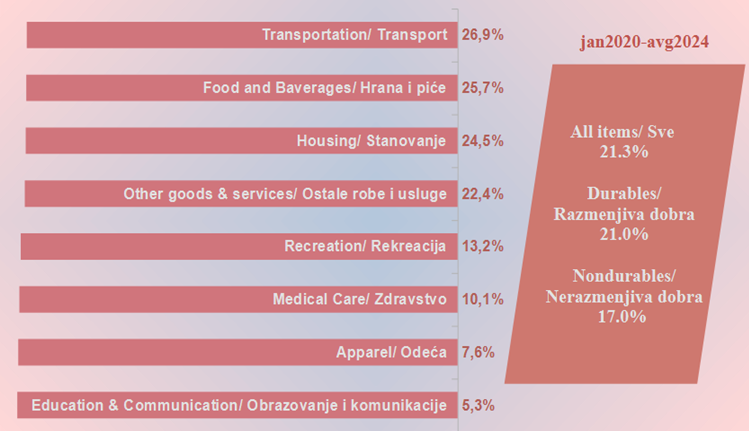
Inflacija u SAD naglo je porasla poslednjih četiri ipo godine. Dvostruko viša od projektovanih 2% po godini. Transport, hrana i stanovanje su najteže pogođeni visokim rastom inflacije. Najmanje su pogođeni obrazovanje, komunikacija i odeća.
Početkom 2020. godine, godine pandemije Covid-19, počela je da se pogoršava globalna ekonomija. Do danas indeks potrošačkih cena je porastao za 21,33%. Kategorije su beležile različite stope rasta cena – jedne su imale značajan rast, dok su se druge jedva menjale. Recimo, najbrže je rastao indeks potrošačkih cena za transport (uključuje: nova i polovna vozila, avio karte, benzin i drugu robu i usluge u vezi sa transportom). Na drugom kraju skale, cene za obrazovanje i komunikacija (uključuju: školarinu, poštarinu i telefonske usluge) porasli su za samo 5,2% u posmatranom periodu.
Uprkos padu inflacije poslednjih meseci (na najniži nivo u više od četiri godine u avgustu od 2,5%) potrošačke cene u Sjedinjenim Državama su naglo porasle u poslednje 56 meseci. Taj rast je dvostuko veći (21,33%) nego što bi inflaciju vodila Fed-ova ciljana stopa inflacije od 2% (10,5%). To ilustruje ozbiljan skok inflacije. Problem ostaje još neko vreme, vreme potrebno da se inflacija vrati na ciljni nivo od 2 procenta, što znači da će se efekti inflatorne krize zadržati. Ostale kategorije rashoda sa natprosečnim porastom cena od početka pandemije su hrana i piće, kao i stanovanje, koji su od januara 2020. porasli za 25,7 odnosno 24,6 odsto. Cene rekreacije, odeće i medicinske nege zabeležile su skromniji rast u poslednje četiri i po godine. Cene energije nisu posebna kategorija, već su uključene u druge kategorije prema njihovoj nameni (cene benzina su uključene u kategoriju prevoza, dok je energija za domaćinstvo uključena u stanovanje).Kada se posmatraju odvojeno, cene energije su zabeležile najveći rast od svih, i porasle su za 27,2 odsto od januara 2020.
Grafik: Kategorije najteže pogođene inflacijom, promena CPI-U u SAD, desezonirano, jan2020-avg2024
Izvor: Biro za popis stanovništva SAD
Inflation in the US has risen sharply over the past four and a half years. Twice as high as the projected 2% per year. Transport, food and housing are the hardest hit by high inflation. The least affected are education, communication and clothing.
At the beginning of 2020, the year of the Covid-19 pandemic, the global economy began to deteriorate. To date, the consumer price index has increased by 21.33%. Categories recorded different rates of price growth – some experienced significant growth, while others barely changed. For example, the fastest growing consumer price index for transportation (includes: new and used vehicles, airline tickets, gasoline and other goods and services related to transportation). At the other end of the scale, prices for education and communication (includes: school fees, postage and telephone services) increased by only 5.2% in the observed period.
Despite falling inflation in recent months (to a more than four-year low of 2.5% in August), consumer prices in the United States have risen sharply over the past 56 months. That growth is twice as high (21.33%) than inflation would be driven by the Fed’s target inflation rate of 2% (10.5%). This illustrates a serious spike in inflation. The problem remains for some time, the time needed for inflation to return to the target level of 2 percent, which means that the effects of the inflationary crisis will persist. Other expenditure categories with above-average price increases since the beginning of the pandemic are food and beverages, as well as housing, which have increased by 25.7 and 24.6 percent, respectively, since January 2020. Prices for recreation, clothing and medical care have seen more modest growth over the past four and a half years. Energy prices are not a separate category, but are included in other categories according to their purpose (gasoline prices are included in the transportation category, while household energy is included in housing). When viewed separately, energy prices have seen the largest increase of all, rising are by 27.2 percent since January 2020.
Figure: Categories hardest hit by inflation, US CPI-U change, seasonally adjusted, Jan2020-Aug2024
Source: U.S. Census Bureau