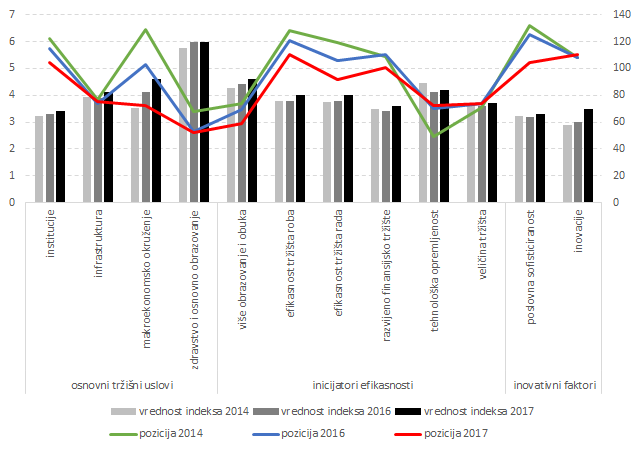
Na svetskoj listi konkurentnosti za 2017. godinu Srbija beleži napredak za 12 pozicija i zaposela je 78 poziciju od 137 ekonomija, sa indeksom od 4,14 (od 7). Međutim, Srbija je i dalje na začelju u odnosu na ekonomije iz okruženja (iza Srbije je jedno Bosna i Hercegovina – 102 pozicija, sa indeksim 3,87).
Posle više godina indeks konkurentnosti za Srbiju je prešao vrednost 4. To konačno, kako ističu mnogi, ukazuje na napredovanje ekonomije, tj. makroekonomsko okruženje je povoljno, raste efikasnost tržišta rada, ali ne i institucija, raste oblast visokog obrazovanja, kao i softificiranost poslovanja, razvijenost finansijskog tržišta. Ipak, pojavljuju se i faktori koji najviše ugrožavaju poslovanje – nepovoljne poreske stope, ali i poreska regulativa, nepovoljan pristup izvorima finansiranja, neefikasnost državne birokratije i korupcija.
Uočljiv je rast vrednosti (gotovo) svih inidikatora u poslednjih par godina. Ali ne i ranga na listi ekonomija. Otkud to da i pad vrednosti indikatora, kao u slučaju tehnološke opremljenosti, može na rang listi poboljšati poziciju? To se javlja kada druge ekonomije sa liste u većoj meri pogoršaju vrednosti svojih indikatora, kao i ako se smanji broj ekonomija obuhvaćenih listom (2016. godine 138 ekonomija, 2015. godine 140 ekonomija, 2014. godine 144 ekonomija). Tako je, recimo, Južnoafrička republika zabeležila pad za 14 pozicija. Nama po rangu bliža, Šri Lanka, beleži isti pad od 14 pozicija, s tim da je u prethodnom izveštaju bila ispred Srbije, na 71. poziciji (vrednost indeksa 4.19), da bi u poslednjem izveštaju bila iza Srbije, na 85. poziciji (vrednost indeksa 4.08). Tako je Makedonija izostavljena iz ovogodišnjeg izveštaja. To znači da pozicioniranje na rang listi konkurentnosti može biti uzrokovano eksternim, a ne samo inernim faktorima. Posebno ja važna činjenica da se podaci prikupljaju za Grad Beograd, ne celu teritoriju Srbije.
Izvor: WEF
In the 2017 Global Competitiveness rankings, Serbia improved by 12 positions and reached 78th place out of 137 economies, with an index score of 4.14 (out of 7). However, Serbia remains at the bottom compared to neighboring economies, with only Bosnia and Herzegovina ranked lower (102nd place, with an index score of 3.87).
After several years, Serbia’s competitiveness index has exceeded the value of 4. This development, as many observers emphasize, indicates progress in the economy: the macroeconomic environment has improved, labor market efficiency has increased, as well as higher education, business sophistication, and the development of the financial market. However, institutional quality has not improved. At the same time, several factors continue to pose the greatest obstacles to doing business, including unfavorable tax rates and tax regulations, limited access to financing, inefficiency of the state bureaucracy, and corruption.
An increase in the values of (almost) all indicators has been observed over the past few years, but this has not always been accompanied by an improvement in ranking among economies. How is it possible that even a decline in the value of certain indicators – such as technological readiness – can result in a higher ranking? This occurs when other economies experience a greater deterioration in their indicator values, or when the number of economies included in the ranking is reduced (138 economies in 2016, 140 in 2015, and 144 in 2014). For example, South Africa recorded a decline of 14 positions. Sri Lanka, which is closer to Serbia in the ranking, experienced the same drop of 14 positions: in the previous report it ranked ahead of Serbia in 71st place (index value 4.19), while in the latest report it fell behind Serbia to 85th place (index value 4.08). North Macedonia was excluded from this year’s report. This indicates that a country’s position in the competitiveness ranking can be influenced by external factors, not only internal ones. A particularly important fact is that the data are collected for the city of Belgrade rather than for the entire territory of Serbia.
Source: WEF