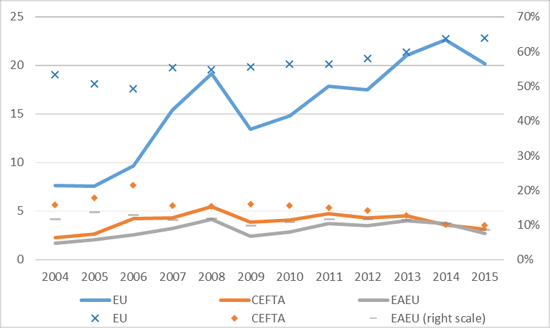
Zahvaljujući snažnijoj saradnji sa Evropskom unijom, Srbija ima odličnu priliku za ekonomski prosperitet. Tokom poslednjih 15 godina potpisani su brojni ugovori sa EU i susednim zemljama, a ukupna vrednost spoljne trgovine Srbije je porasla. Na slici su prikazane vrednosti trgovine između Srbije i zemalja EU u periodu od 2001. do 2015. godine.
Kao što se može videti, Srbija je tokom posmatranog perioda više od 80% ukupne spoljne trgovine ostvarivala sa ove tri grupe zemalja. Najveći obim trgovine Srbija je ostvarivala sa zemljama EU, preko 50%. Obim trgovine sa zemljama CEFTA-e menjao se iz godine u godinu. U 2007. godini zabeležen je pad, jer su Rumunija i Bugarska postale članice EU, dok je 2013. godine, kada je Hrvatska pristupila EU, registrovano blago smanjenje. Shodno tome, tokom posmatranog perioda obim trgovine sa zemljama EU je rastao, dok se trgovina sa zemljama CEFTA-e smanjivala.
Najveći problem za Srbiju jeste to što se njeni glavni spoljnotrgovinski partneri tokom ovog perioda nisu značajno promenili. Pored Rusije, Nemačke i Italije, Srbija je u velikoj meri usmerena na balkanske zemlje. Sa balkanskim (CEFTA) zemljama Srbija ostvaruje suficit u trgovini zahvaljujući izvozu poljoprivrednih proizvoda, gvožđa i čelika. Taj suficit pomaže u smanjenju deficita u trgovini sa zemljama EU. Izvoz bi mogao biti i veći kada trenutni nivo trgovine ne bi bio znatno ispod svog potencijala.
Kao i u drugim tranzicionim zemljama, sa otvaranjem privrede nivo spoljne trgovine Srbije sa zemljama EU je porastao u odnosu na druge zemlje, naročito susedne. U ekonomiji se ovaj proces naziva preusmeravanje trgovine i, zajedno sa stvaranjem trgovine, predstavlja jedan od dva najvažnija efekta sporazuma o slobodnoj trgovini (FTA). U slučaju Srbije situacija je donekle drugačija. Naime, mnoge zemlje obuhvaćene CEFTA sporazumom su bivše jugoslovenske republike, a Srbija je sa njima povezana kako ekonomski, tako i politički. Imajući to u vidu, ukupan obim trgovine između Srbije i ostalih CEFTA zemalja mogao bi biti znatno veći.
Owing to a stronger cooperation with the EU, Serbia has an excellent opportunity to prosper economically. Over the last 15 years many contracts with EU and neighbouring countries have been signed and the total value of Serbia’s international trade has increased. Figure presents the values of trade between Serbia and EU countries, from 2001 to 2015.
As can be seen, Serbia was fulfilled more than 80% of the total external trade with these three groups of countries during the reporting period. The largest volume of trade Serbia realize with EU countries, over 50%. The volume of trade with CEFTA countries was changing from year to year. In 2007 there was a decline because Romania and Bulgaria became EU members, while 2013, when Croatia associated to the EU, recorded a slight decrease. Hence, during the period, the volume of trade with EU countries was increasing while with CEFTA countries was decreasing.
The biggest problem for Serbia is that its main trading partners did not change significantly during this period. Apart from Russia, Germany, and Italy, Serbia is largely concentrated on the Balkan countries. With the Balkan (CEFTA) countries Serbia has a trade surplus owing to the export of agricultural products, iron, and steel. The surplus helps to diminish the deficit with EU countries. Exports could even be higher if the current level of trade was not much lower than its potential.
As in other transition countries, with the opening of the economy the level of Serbia’s external trade with EU countries rose in relation to other countries, especially neighbouring ones. In economy this is called the trade direction, and together with the trade creation it presents one of the two most important effects of a free trade agreement (FTA). In the case of Serbia the situation is slightly different. Namely, many countries included in the CEFTA agreement are former Yugoslav republics and Serbia is linked with them in economic and political fields. Having said that, the level of the total trade between Serbia and other CEFTA countries could be much higher.