Otkrivene komparativne prednosti u srpskoj ekonomiji popravljaju se poslednjih nekoliko godina, ali Srbija i dalje (-16,86%) beleži vrednosti lošije nego 1989. godine (-7,3%).
Ukupna razmena Srbije sa svetom imala je bolje performanse u 1989. godini nego nakon otvaranja privrede poslednjih 15 godina. Iako, i tada u deficitu (7,3%), početkom 2000-ih godina Srbija je dostigla deficit od 50% (2001. 42,47%, 2002. 46,02%, 2003. 46,13%, 2004. 50,63%), što odražava značajan gubitak konkurentnosti celokupne ekonomije na svetskom tržištu. Poslednjih godina, rezultati se popravljaju tako da je u 2013. godini RCA indeks smanjen na nivo od -16,86%.
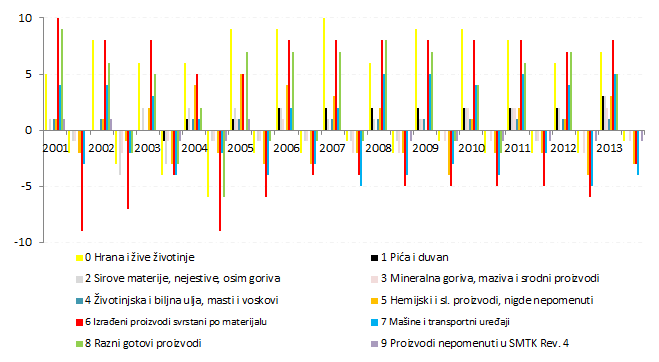
Dublja analiza, analiza 50 grupa proizvoda sa najvećim učešćem u robnoj razmeni, pokazuje da se poslednjih godina povećava broj proizvoda sa pozitivnim RCA, gde Srbija beleži komparativne prednosti. U 2013. godini zabeleženo je 37 grupa proizvoda sa pozitivnim RCA i svega 13 grupa proizvoda sa negativnim RCA, što je najbolji rezultat od 2001. godine.
Posmatrano po sektorima privrede, srpska ekonomija ima najviše grupa proizvoda sa komparativnim prednostima u sektoru 6 (Izrađeni proizvodi svrstani po materijalu) i sektoru 0 (Hrana i žive životinje). Odmah iza su sektor 9 (Razni gotovi proizvodi), sektor 7 (Mašine i transportni uređaji), pa i sektor 5 (Hemijski i sl. proizvodi, nigde nepomenuti). To pokazuje da se šanse za međunarodnu konkurentnu tržišnu utakmicu trebaju tražiti u prerađivačkoj industriji. Ostaje samo pitanje, koliko će pažnje da se posveti tehnološko intenzivnijim proizvodnim procesima, koji garantuju privredni rast u srednjem roku.
Otkrivene komparativne prednosti (RCA) predstavljaju odnos spoljnotrgovinskog deficita i ukupnog obima razmene sa inostranstvom. Pozitivne vrednosti ovog koeficijenata predstaljvaju suficit u razmeni i odražavaju komparativnu prednost. Važi i obratno, negativne vrednosti ovog koeficijenata predstaljvaju deficit u razmeni i odražavaju gubitak komparativnih prednosti.
Napomena: kalkulacije autora na bazi podataka RZS
Revealed comparative advantages in the Serbian economy have improved over the past few years; however, Serbia still records worse values (-16.86%) than in 1989 (-7.3%).
Serbia’s total trade with the world performed better in 1989 than in the period following the economic opening over the last 15 years. Although trade was already in deficit at that time (7.3%), in the early 2000s Serbia reached a deficit of nearly 50% (42.47% in 2001, 46.02% in 2002, 46.13% in 2003, and 50.63% in 2004), reflecting a significant loss of competitiveness of the overall economy in the global market. In recent years, results have improved, and by 2013 the RCA index was reduced to -16.86%.
A deeper analysis of 50 product groups with the largest share in merchandise trade shows an increasing number of products with positive RCA values, indicating comparative advantages for Serbia. In 2013, 37 product groups recorded positive RCA values, while only 13 groups had negative RCA values, representing the best result since 2001.
From a sectoral perspective, the Serbian economy shows the largest number of product groups with comparative advantages in Sector 6 (Manufactured goods classified chiefly by material) and Sector 0 (Food and live animals). These are followed by Sector 9 (Miscellaneous manufactured articles), Sector 7 (Machinery and transport equipment), and Sector 5 (Chemicals and related products, n.e.s.). This indicates that opportunities for international competitiveness should be sought primarily within the manufacturing industry. The key remaining question is the extent to which attention will be devoted to more technologically intensive production processes, which are crucial for medium-term economic growth.
Revealed comparative advantage (RCA) represents the relationship between the foreign trade balance and the total volume of international trade. Positive values of this indicator reflect a trade surplus and indicate comparative advantage, while negative values reflect a trade deficit and a loss of comparative advantages.
Note: Author’s calculations based on data from the Statistical Office of the Republic of Serbia.