Srpska privreda raspolaže daleko više prirodnim i fizičkim resursima, nego kapitalnim resursima, pa se stoga svrstava, prema konceptu faktorske intenzivnosti, u zemlje koje su specijalizovane za proizvodnju proizvoda koji u većem obimu sadrže prirodne impute (fizički rad i prirodne resurse) a manjem obimu proizvodne impute (ljudske resurse i tehnologiju).
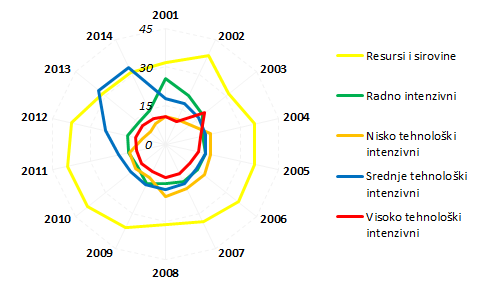
U periodu 2000-2013. godina struktura robnog izvoza u srpskoj privredi nije se značajno promenila, ne toliko da bi dovela do unapređenja konkurentskih pozicija srpske privrede na svetskom tržištu. Tokom posmatranog perioda najveće je učešće prirodnih resursa u strukturi robnog izvoza sa oko jednom trećinom ukupnog robnog izvoza. Istovremeno, povećano je učešće tehnološki intenzivnih proizvoda (rast sa 40,1% u 2000. godini na 52,8% u 2013. godini), najvećim delom na uštrb radno intenzivnih proizvoda (pad sa 23,4% u 2000. godini na 13,3% u 2013. godini).
Kod tehnološki intenzivnih proizvoda rast učešća u izvozu imaju srednje-tehnološki proizvodi, pad beleže nisko-tehnološki intenzivni proizvodi, dok visoko-intenzivni proizvodi u posmatranom periodu učestvuju sa između 10 i 14% u ukupnom robnom izvozu (sa izuzetkom 2003. godine kada je to učeđće iznosilo 19,4%). U 2013. godini srpska privreda je značajno povećala učešće srednje-tehnološki intenzivnih proizvoda (na 33,6% ukupnog izvoza) unutar strukture robnog izvoza zahvaljujući rastu narudžbina proizvoda iz grupa Mašine, Oprema i Putnički automobili.
U 2013. godini struktura robnog izvoza pokazuje da se srpska privreda, sa aspekta tehnološke intenzivnosti proizvoda, suočila sa poboljšanjem konkurentskih pozicija u odnosu na 2000. godinu, pošto je povećano učešće proizvodnih kategorija koje mogu obezbediti privredni rast, u srednjem roku, i u budućnosti unapređivati konkurentnost domaće proizvodnje (srednje-tehnološki i visoko-tehnološki intenzivnih proizvoda). Smanjeno je učešće prirodnih resursa i sirovina, radno-intenzivnih proizvoda i nisko-intenzivnih proizvoda (sa 69,1% iz 2000. godine na 52,4% u 2013. godini), ali je ono i dalje visoko što utiče na veći obim proizvodnje proizvoda nižih faza prerada i low-tech proizvoda. Komparativne prednosti srpska privreda ostvaruje prvenstveno kod primarnih proizvoda i proizvoda nižih faza prerade. Izvoz zasnovan na proizvodima iz ovih grupa i sektora (resursi i radno-intenzivna industrija), po pravilu, ne predstavlja osnov za dugoročni rast izvoza i privredni rast i razvoj.
The Serbian economy is endowed with significantly more natural and physical resources than capital resources. Accordingly, within the framework of factor intensity theory, Serbia is classified among countries specialized in the production of goods that rely more heavily on natural inputs (physical labor and natural resources) and to a lesser extent on production inputs such as human capital and technology.
During the period 2000–2013, the structure of merchandise exports in the Serbian economy did not change significantly enough to lead to a substantial improvement in the country’s competitive position on the global market. Throughout the observed period, natural resources accounted for the largest share of merchandise exports, at approximately one third of total exports. At the same time, the share of technologically intensive products increased (from 40.1% in 2000 to 52.8% in 2013), largely at the expense of labor-intensive products (which declined from 23.4% in 2000 to 13.3% in 2013).
Within the group of technologically intensive products, the export share of medium-technology products increased, while low-technology products recorded a decline. High-technology products accounted for between 10% and 14% of total merchandise exports during the observed period (with the exception of 2003, when their share reached 19.4%). In 2013, the Serbian economy significantly increased the share of medium-technology-intensive products (to 33.6% of total exports) within the export structure, driven by rising orders in the product groups Machinery, Equipment, and Passenger Cars.
In 2013, the structure of merchandise exports indicates that, from the perspective of technological intensity, the Serbian economy experienced an improvement in its competitive position compared to 2000. This improvement reflects the increased share of product categories capable of supporting economic growth in the medium term and enhancing the future competitiveness of domestic production (medium- and high-technology-intensive products). The share of natural resources and raw materials, labor-intensive products, and low-technology-intensive products declined (from 69.1% in 2000 to 52.4% in 2013); however, this share remains high, contributing to a larger volume of production concentrated in lower stages of processing and low-technology products.
Serbia’s comparative advantages are primarily realized in primary products and products at lower stages of processing. Export growth based on these groups and sectors (resource-based and labor-intensive industries) generally does not constitute a sustainable foundation for long-term export expansion, economic growth, and development.