Unutar EU postoji značajna neujednačenost u individualnoj potrošnji država članica. Iznad proseka EU dominiraju najveće i najrazvijenije ekonomije, dok su daleko ispod proseka nove članice EU. Srbija je prema podacima za 2017. godinu daleko ispod nivoa poslednje rangirane članice EU, Bugarske. Srbija ne dostiže ni polovinu potrošnje EU.
Stvarna individualna potrošnja (AIC) predstavlja meru materijalnog bogatstva jednog domaćinstava. Unutar EU, prema podacima za 2017. godinu, AIC po glavi stanovnika meren kupovnom moći (PPS) varirao se od 54% (Bugarska) do 132% (Luksemburg) proseka Evropske unije (EU).
Deset država članica je zabeležilo AIC po glavi stanovnika iznad proseka EU u 2017. godini. Najveći nivo u EU zabeležen je u Luksemburgu, 32% iznad prosjeka EU. Slede, Nemačka sa 22%, Austrija sa 17%, Velika Britanija i Danska sa 14%, Finska i Belgija sa 12%, Holandija sa 11%, Švedska 9% i Francuska 8% iznad proseka EU. Od 2013. godine sve navedene ekonomije beleže kontinuirani pad u individualnoj potrošnji domaćinstava. Slične tendencije pokazuje i GDP po glavi stanovnika (mera ekonomske aktivnosti), s tim da blago odstupaju Velika Britanija i Finska – ispoljavaju veću potrošnju u odnosu na nivo GDP PPS poredeći sa ostalim navedenim ekonomijama.
Odmah ispod proseka evropske individualne potrošnje je Italija (2%), zatim Irska (7%) i Kipar (8%), dok značajno zaostaju Španija (11%), Litvanija (12%), Portugalija i Češka (18%). Države članice od 2004. godine beležile su 20% i više ispod proseka EU.
Mađarska i Hrvatska dostigle su nivo individualne potrošnje po glavi stanovnika od 62% EU, a Bugarska još niže, svega 54% EU.
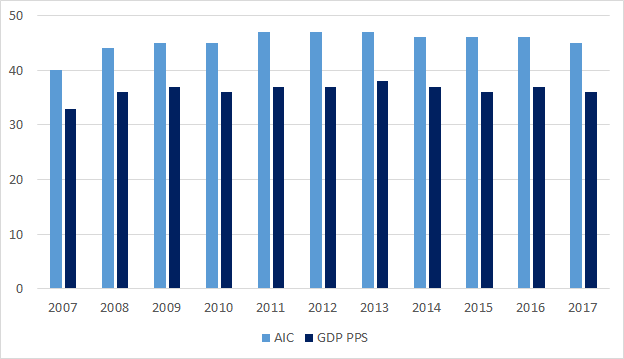
Srbija tokom posmatranog perioda (2007-2017) ne dostiže ni polovinu indiviualne potrošnje (45%) EU niti polovinu BDP merenog nivoom kupovne moći (36%) EU. Stagnacija srpske ekonomije u odnosu na EU je zabrinjavajuća. Sa pravom se može postaviti pitanje rasta prosečnih zarada a istovremeno niskog nivoa BDP. Sasvim je izvesno da je niska produktivnost privrede a da fiskalna politika nije podsticajna. Zapravo, da bi se ovaj gep u odnosu na EU prosek, pa i EU države članice smanjio neophodan je intenzivan rast podstaknut adekvatnom fiskalnom i monetarnom politikom (izvan brojki kriterijuma konvergencije).
- Stvarna individualna potrošnja (AIC) se sastoji od roba i usluga koji se pojedinačno troše, bez obzira na to da li su te robe i usluge kupljene i plaćene od strane domaćinstava, od strane vlade ili od neprofitnih organizacija.
- Standard kupovne moći (PPS) je veštačka jedinica koja eliminiše razlike u ceni između zemalja. Tako jedan PPS kupuje isti obim robe i usluga u svim zemljama. Ova jedinica omogućava značajno upoređivanje ekonomskih indikatora po zemljama.
Izvor: kalkulacije autora prema podacima Eurostat
Within the European Union, there is significant disparity in individual consumption across Member States. Above the EU average are predominantly the largest and most developed economies, while the newer EU Member States remain well below the average. According to 2017 data, Serbia is far below the level of the lowest-ranked EU Member State, Bulgaria. Serbia does not reach even half of the EU level of individual consumption.
Actual individual consumption (AIC) represents a measure of the material well-being of households. Within the European Union, according to 2017 data, AIC per capita measured in purchasing power standards (PPS) ranged from 54% of the EU average in Bulgaria to 132% in Luxembourg.
Ten EU Member States recorded AIC per capita above the EU average in 2017. The highest level was observed in Luxembourg, 32% above the EU average, followed by Germany (22%), Austria (17%), the United Kingdom and Denmark (14%), Finland and Belgium (12%), the Netherlands (11%), Sweden (9%), and France (8%) above the EU average. Since 2013, all of these economies have experienced a continuous decline in household individual consumption. Similar trends can be observed in GDP per capita (a measure of economic activity), although the United Kingdom and Finland deviate slightly, exhibiting higher consumption relative to GDP measured in PPS compared to the other listed economies.
Immediately below the EU average of individual consumption are Italy (2% below), followed by Ireland (7%) and Cyprus (8%), while Spain (11%), Lithuania (12%), Portugal and the Czech Republic (18%) lag significantly behind. Member States that joined the EU from 2004 onwards have generally recorded levels of individual consumption that are 20% or more below the EU average.
Hungary and Croatia reached a level of individual consumption per capita equivalent to 62% of the EU average, while Bulgaria remains significantly lower, at only 54% of the EU average.
During the observed period (2007–2017), Serbia did not reach even half of the EU level of individual consumption (45%), nor half of GDP measured in purchasing power standards (36%). The stagnation of the Serbian economy relative to the EU is therefore a matter of concern. This raises legitimate questions regarding the growth of average wages alongside persistently low GDP levels. It is evident that productivity remains low and that fiscal policy has not been sufficiently stimulative. In order to reduce this gap relative to the EU average, as well as to EU Member States, robust economic growth supported by appropriate fiscal and monetary policies is required, beyond mere compliance with numerical convergence criteria.
- Actual individual consumption (AIC) consists of goods and services that are individually consumed, regardless of whether these goods and services are purchased and paid for by households, the government, or non-profit institutions.
- The purchasing power standard (PPS) is an artificial unit that eliminates price level differences between countries. One PPS purchases the same volume of goods and services in all countries, thereby enabling meaningful cross-country comparisons of economic indicators.
Source: author’s calculations based on Eurostat data