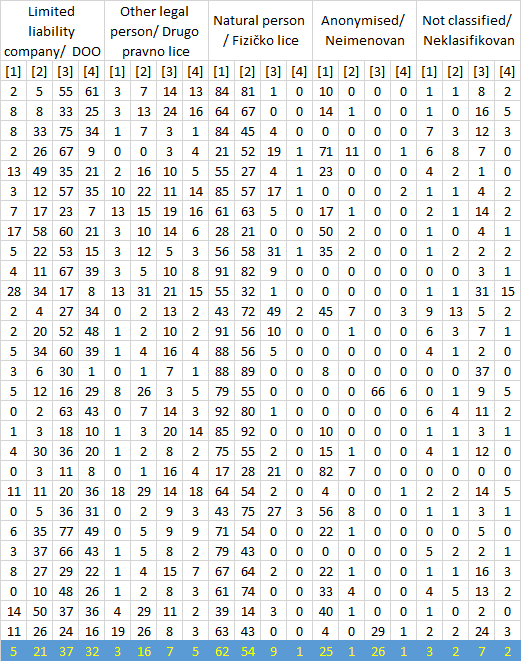
Koliko je preraspodela među korisnicima preko 60% budžeta EU (zajednička poljoprivredna politika, ZPP, plus Koheziona politika, KP), transparentna? U 2019. godini fizička lica su bili najveći direktni korisnici (62% [1]) i najveći primaoci (54% [2]) sredstava ZPP. U periodu 2014-20 društva sa ograničenom odgovornošću (37% [3]) bila su najveći direktni korisnik, a administracija najveći primalac (49% [4]) sredstava iz KP.
Većina direktnih korisnika za ZPP u 2019. [1] (veoma slična onoj u ZPP 2018.) su fizička lica čine većinu (62%) direktnih korisnika (uključujući fizička lica, pojedinačna preduzeća i partnere bez pravnog lica). Stvarni udeo fizičkih lica je veći jer je oko četvrtine direktnih korisnika anonimizovano (25%) 2019. (u poređenju sa 27% u 2018). Državne uprave (3%), društva sa ograničenom odgovornošću (5%) i druga pravna lica (3%) čine samo manjinu direktnih korisnika (u poređenju sa 2%, 4%, 3%, respektivno u 2018). Preostalih 3% direktnih korisnika nije bilo moguće klasifikovati (ostao isti kao u 2018). Udeo anonimizovanih direktnih korisnika smanjen je sa 2% u 2018. na 1% u 2019.
Udeo sredstava koje primaju javne uprave (5%) ostao je isti. Društva sa ograničenom odgovornošću (21%) i druga pravna lica (16%) zadržale su nivo učešća u 2019., i one čine manje od četvrtine njihovog učešća u direktnim korisnicima. Udeo direktnih korisnika koji nisu mogli da se klasifikuju ostao je isti u 2019. godini u odnosu na 2018. godinu (2%).
Kod KP u periodu 2014-2020. niti jedan tip korisnika koji nije činio jasnu većinu direktnih korisnika sredstava kohezionog fonda [3]. Najbrojniji tip direktnih korisnika su društva sa ograničenom odgovornošću koja čine oko 37% direktnih korisnika, koje su sa 26% sledili Anonimizovani direktni korisnici. Ostali direktni korisnici su imali jednocifrene uedele – Javna uprava (8% direktnih korisnika), fizička lica (9%), subjekti javnog sektora (4%) i druga pravna lica (7%). Preostalih 7% direktnih korisnika nije moglo biti klasifikovano.
Raspodela sredstava iz kohezionih EU fondova [4] najvećim delom bila je usmerena prema javnim upravama i subjektima javnog sektora. Javne uprave su dobile 49% sredstava EU za KP, a povezani subjekti javnog sektora (univerzitet, javne bolnice, itd.) dobili su 11%, što je zajedno 60% EU fondova. Na društva sa ograničenom odgovornošću otpada 32% sredstava. Ostala pravna lica (5%), fizička lica (1%) i anonimizovani (1%) direktni korisnici su činili samo malu manjinu sredstava. Takođe, u smislu EU fondova, mali deo (2%) direktnih korisnika nije mogao biti klasifikovana.
Izvor: Evropski Parlament
Napomene: „0%“ je prikazano u tabeli, što znači da je to zanemarljivo mali udeo, a ne bukvalno nula procenata
[1] Direktni korisnici zajedničke poljoprivredne politike 2019 (udeo korisnika)
[2] Direktni korisnici zajedničke poljoprivredne politike 2019 (udeo dobijenih sredstava EU)
[3] Direktni korisnici kohezionih fondova 2014-20 (udeo korisnika)
[4] Direktni korisnici kohezionih fondova 2014-20 (udeo dobijenih sredstava)
How transparent is the redistribution of over 60% of the EU budget (common agricultural policy, CAP, plus Cohesion Policy, KP) among beneficiaries? In 2019, natural persons were the largest direct beneficiaries (62% [1]) and the largest recipients (54% [2]) of ZPP funds. In the period 2014-20, limited liability companies (37% [3]) were the largest direct beneficiary, and the administration was the largest recipient (49% [4]) of funds from the KP.
The majority of direct beneficiaries for CAP in 2019 [1] (very similar to CAP 2018) are natural persons making up the majority (62%) of direct beneficiaries (including natural persons, sole proprietorships, and partners without legal entity). The actual share of natural persons is higher as about a quarter of direct users were anonymized (25%) in 2019 (compared to 27% in 2018). State administrations (3%), limited liability companies (5%), and other legal entities (3%) make up only a minority of direct beneficiaries (compared to 2%, 4%, and 3%, respectively, in 2018). The remaining 3% of direct users could not be classified (remained the same as in 2018). The share of anonymized direct users decreased from 2% in 2018 to 1% in 2019.
The share of funds received by public administrations (5%) remained the same. Limited liability companies (21%) and other legal entities (16%) maintained their level of participation in 2019, and they account for less than a quarter of their participation in direct beneficiaries. The share of direct users who could not be classified remained the same in 2019 compared to 2018 (2%).
At the CP in the period 2014-2020. not a single type of user that did not make up a clear majority of direct users of cohesion fund funds [3]. The most numerous type of direct users is limited liability companies, which make up about 37% of direct users, followed by Anonymous direct users with 26%. Other direct users had single-digit shares – Public administration (8% of direct users), natural persons (9%), public sector entities (4%), and other legal entities (7%). The remaining 7% of direct users could not be classified.
The distribution of funds from cohesion EU funds [4] was mostly directed toward public administrations and public sector entities. Public administrations received 49% of EU funds for KP, and related public sector entities (universities, public hospitals, etc.) received 11%, which is a total of 60% of EU funds. Limited liability companies account for 32% of funds. Other legal entities (5%), natural persons (1%), and anonymized (1%) direct beneficiaries accounted for only a small minority of funds. Also, in terms of EU funds, a small part (2%) of direct beneficiaries could not be classified.
Source: European Parliament
Note: “0%” is displayed in the table it means that it is a negligible small share and not a literal zero per cent
[1] Direct beneficiaries of Common Agricultural Policy 2019 (share of beneficiaries)
[2] Direct beneficiaries of Common Agricultural Policy 2019 (share of EU funds received)
[3] Direct beneficiaries of Cohesion Funds 2014-20 (share of beneficiaries)
[4] Direct beneficiaries of Cohesion Funds 2014-20 (share of beneficiaries)