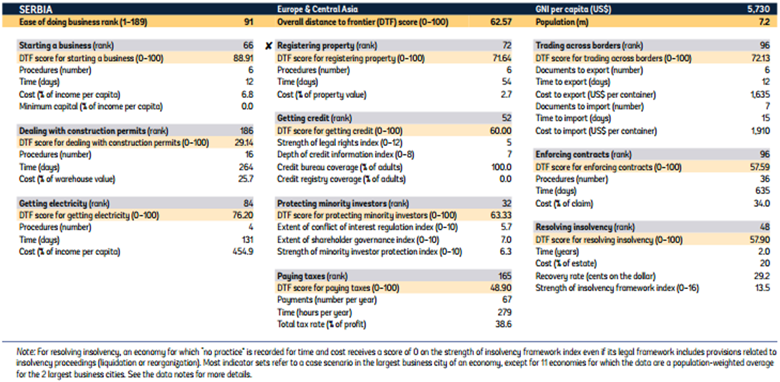
Izveštaj Svetske banke o poslovanju za 2015. godinu (Doing Business 2015) potvrdio je da se godinama unazad malo radilo na poboljšanju poslovnog ambijenta u srpskoj ekonomiji. Nepovoljan rezultat (rang 91 od 189 zemalja) nije novitet, jer je poblem nepovoljnog poslovnog ambijenta postao hroničan i zabrinjavajući (najbolji rezultat Srbija imala 2006, kada je po rangu bila 68 od 175 zemalja).
Srbija nastavlja sa nepovoljnim rangom i za 2015. godinu. Istina, rezultat je nešto bolji nego rezultati za 2014. godine (rang 93), ali i dalje na zavidno niskom nivou. Najveći problem i dalje imamo kod izdavanja dozvola za građevinarstvo (2015. rang 186, a 2006. bio 157) i plaćanje poreza (2015. rang 165, a 2006. bio 168). Problemi postoje i kod prekogranične trgovine (2015. rang 96, a 2006. bio 51) i rešavanja trgovinskih sporova (2015. rang 96, a 2006. bio 76).
Dostignuti loši rezultati poslovanja su posledica očigledno neprecizno sprovođenih reformi privrede u prethodnim godinama. Zakonska regulativa trebala je da ima za cilj obezbeđivanje lakšeg osnivanja preduzeća, tržišnog i fer poslovanja unutar privrede, i podsticanja preduzetništva uz unapređenje MSP. Međutim, nije dala željene rezultate, i kao rezultat imamo višegodišnje loših konkurentskih pozicija cele privrede.
Uopšteno posmatrano, srpsko tržište za investitora nije privlačno jer mu je za građevinsku dozvolu potrebno 264 dana, uz 16 različitih procedura, a da bi registorovao imovinu potrebna su mu čak 52 dana. Takođe, vreme kao važan resurs nepotrebno se troši na plaćanje poreskih dažbina (279 sati godišnje), izozne i uvozne poslove (12, odnosno 15 dana), kao i dugotrajne trgovinske sporove (635 dana). Jedine prednosti ogledaju se u brzini osnivanja preduzeća, visokom stepenu zaštite imovine, pa i MSP i relativno brzom otklanjanju problema nesolventnosti unutar privrede.
Izvor: Doing Business 2015
The World Bank’s Doing Business 2015 report confirmed that little has been done over many years to improve the business environment in the Serbian economy. The unfavorable result (91st out of 189 countries) is not a novelty, as the problem of an adverse business climate has become chronic and increasingly concerning (Serbia’s best performance was recorded in 2006, when it ranked 68th out of 175 countries).
Serbia continued to record an unfavorable ranking in 2015. Although the result was slightly better than in 2014 (93rd place), it still remained at an unsatisfactorily low level. The most serious problems persist in dealing with construction permits (186th place in 2015 compared to 157th in 2006) and paying taxes (165th place in 2015 compared to 168th in 2006). Difficulties are also evident in trading across borders (96th place in 2015 compared to 51st in 2006) and enforcing contracts (96th place in 2015 compared to 76th in 2006).
These persistently poor business performance results are clearly the consequence of imprecisely implemented economic reforms in previous years. Legislative regulation was intended to facilitate easier business start-ups, ensure market-oriented and fair competition, and encourage entrepreneurship while strengthening small and medium-sized enterprises (SMEs). However, these objectives were not achieved, resulting in years of weak competitive positions across the entire economy.
Overall, the Serbian market is not attractive to investors, as obtaining a construction permit requires 264 days and 16 separate procedures, while registering property takes as many as 52 days. In addition, time – an essential resource – is unnecessarily consumed by tax compliance (279 hours per year), export and import procedures (12 and 15 days, respectively), and lengthy commercial dispute resolution (635 days). The only advantages lie in the relatively fast process of starting a business, a high level of property protection, including for SMEs, and comparatively efficient insolvency resolution.